|
Most educators are familiar with Bloom's Taxonomy. Proposed and created in 1956 by Benjamin Bloom and a committee of educators, it is a classification of the different objectives and skills students should learn from specific course content. The taxonomy was updated in 2001 by Anderson and Krathwohl to focus on six levels of learning: Remember, Understand, Apply, Analyze, Evaluate, and Create. As you can see below in the first image, Anderson and Krathwohl shifted the taxonomy from nouns to active verbs. 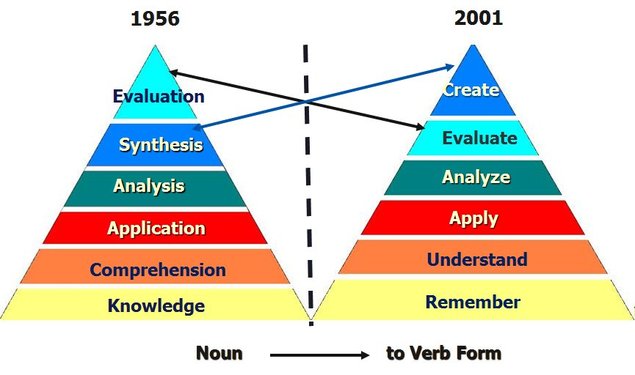 You will often see Bloom's presented as a hierarchical, step approach (either as a pyramid or steps). It is important to note that the learning at the higher levels is dependent on the student having the prerequisite knowledge and skills at the lower levels. So each level can be built on the foundation of the previous levels. However, you can also think of Bloom's functioning at the same time, depending on your learner, your learning context, and your course content. The second image seen below helps educators think of these levels and how they branch out to emphasize and support our different types of learners. Note how each outer circle presents a different way of using the taxonomy levels. You have words that will help you as your write your learning objectives followed by examples of activities you can use as assessments to align to each of your learning objectives. Finally, you have different learning styles connected to all that come in the earlier circles. 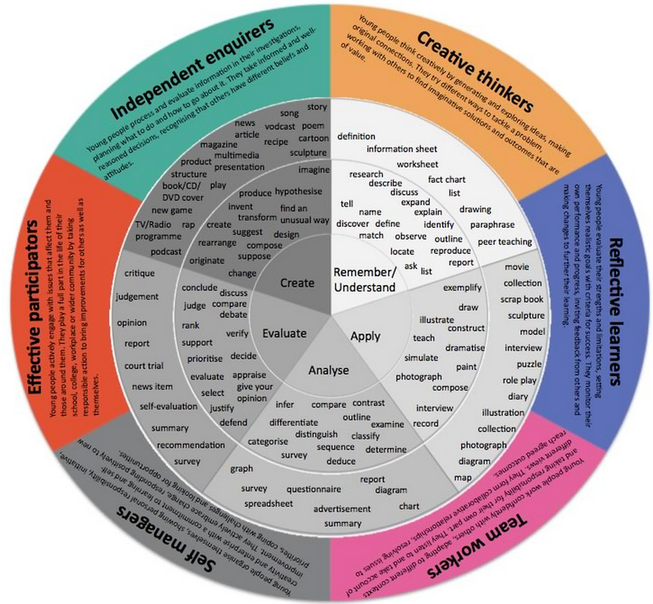 As we extend our knowledge of Bloom's Taxonomy, we should start to think how we can extend our students' understanding and practice. We should emphasize and support 21st century learning in our classrooms. The image seen below helps educators think through digital activities aligned with each level of Bloom's. Note that the activities are simply categories and not specific tools. You have the freedom to choose tools that will support these activities. In fact, ask your students to identify digital tools that would be useful for the activities to increase their buy-in to the learning process. For instance, you (or your students) might choose to use Voicethread as your tool. Voicethread can be used on multiple levels, such as for Understanding, Applying, Analyzing, and Evaluating. It all comes down to what your objective is and what information and/or skill you want your students to learn. 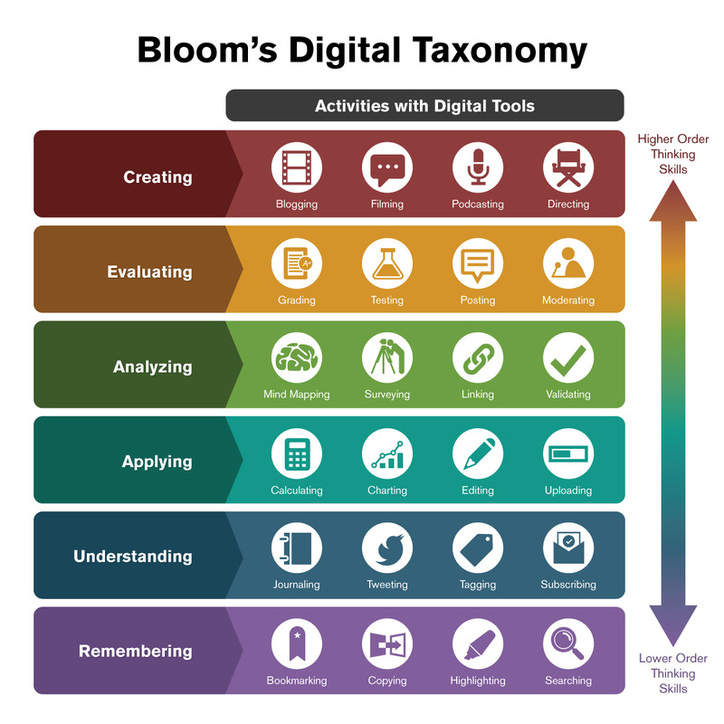 Remember, your course objectives should align with your lesson objectives which, in turn, align with your assessments which then align with your evaluation processes. Each lesson objective should focus on helping your students demonstrate the mastery of your course objectives. The lesson objectives directly support the course objectives, and they all should build up the Bloom's taxonomy to help your students show learning mastery over time. For more resources, check out what the University of Arkansas is doing: Using Bloom’s Taxonomy to Write Effective Learning Objectives Learning Objectives – Examples and Before/After Bloom’s Taxonomy Verb Chart Digital Approaches to Bloom’s Taxonomy Finally, just for fun: Bloom’s Taxonomy According to Seinfeld Your comment will be posted after it is approved.
Leave a Reply. |
Archives
April 2017
Categories
All
|
 RSS Feed
